AETHER / DODEXAPractical blueprint / 2026

BUILD THE ROBOT NOW.
RESEARCH THE MUSCLE BESIDE IT.

A source-backed path to a modular field robot using qualified electric joints, hybrid manufacturing, local autonomy, and satellite backhaul—without pretending the speculative active lattice is already production-ready.

Concept blueprint of a practical hybrid DODEXA robot with conventional joint drives and experimental tendon cartridges

RecommendationHybrid robot / isolated active-matter research

00 / Reality split

Most of the robot is possible.
The miracle muscle is not yet the foundation.

Today’s viable machine is modular: proven metal and composite structure, electric servo joints, torque feedback, protected wiring, local safety control, and replaceable outer systems.

DODEXA’s distributed, self-recovering artificial muscle remains a research cartridge. It can be developed on the same robot only when the conventional architecture can bypass it safely.

01 / Reference architecture

A robot with two clocks.

The production clock advances through qualified modules. The research clock advances only when each active-matter cartridge produces repeatable evidence.

01Build now

Qualified load path

Use machined aluminum or composite tubes for long links, steel bearing inserts, and metal additive manufacturing only where complex joint nodes, cooling channels, or instrumented lattice zones justify it.

Conventional structure first / printed complexity only where measured
02Build now

Electric joint cartridge

Start with integrated servo actuators or frameless motors plus proven reduction, brakes, hard stops, dual position sensing, and output torque sensing. The robot must remain controllable without an experimental muscle.

Serviceable module / local brake / known failure state

03Research beside it

DODEXA tendon cartridge

Mount the lattice tendon in parallel on an instrumented joint or bypassable limb. It can add compliance, sensing, or experimental force without becoming the only safety-critical load path.

Bypassable / replaceable / independently measured

04Build now

Local reflex layer

Joint drives, torque feedback, collision response, braking, and emergency stop live on a physically bounded local control network with an independent safety controller.

No cloud dependency / no satellite route to the servo bus

05Build now

Edge autonomy

Onboard perception and planning use cameras, range sensing, IMUs, encoders, force sensing, and a local mission cache. Loss of every external link must still produce a stable, predictable state.

Sense locally / decide locally / degrade locally

06Build now

Replaceable soft systems

Use TPU harness ducts, silicone joint boots, tactile pads, localized electronics encapsulation, and removable impact panels. Never pot an entire limb into an unrepairable block.

Seal locally / inspect interfaces / preserve service access
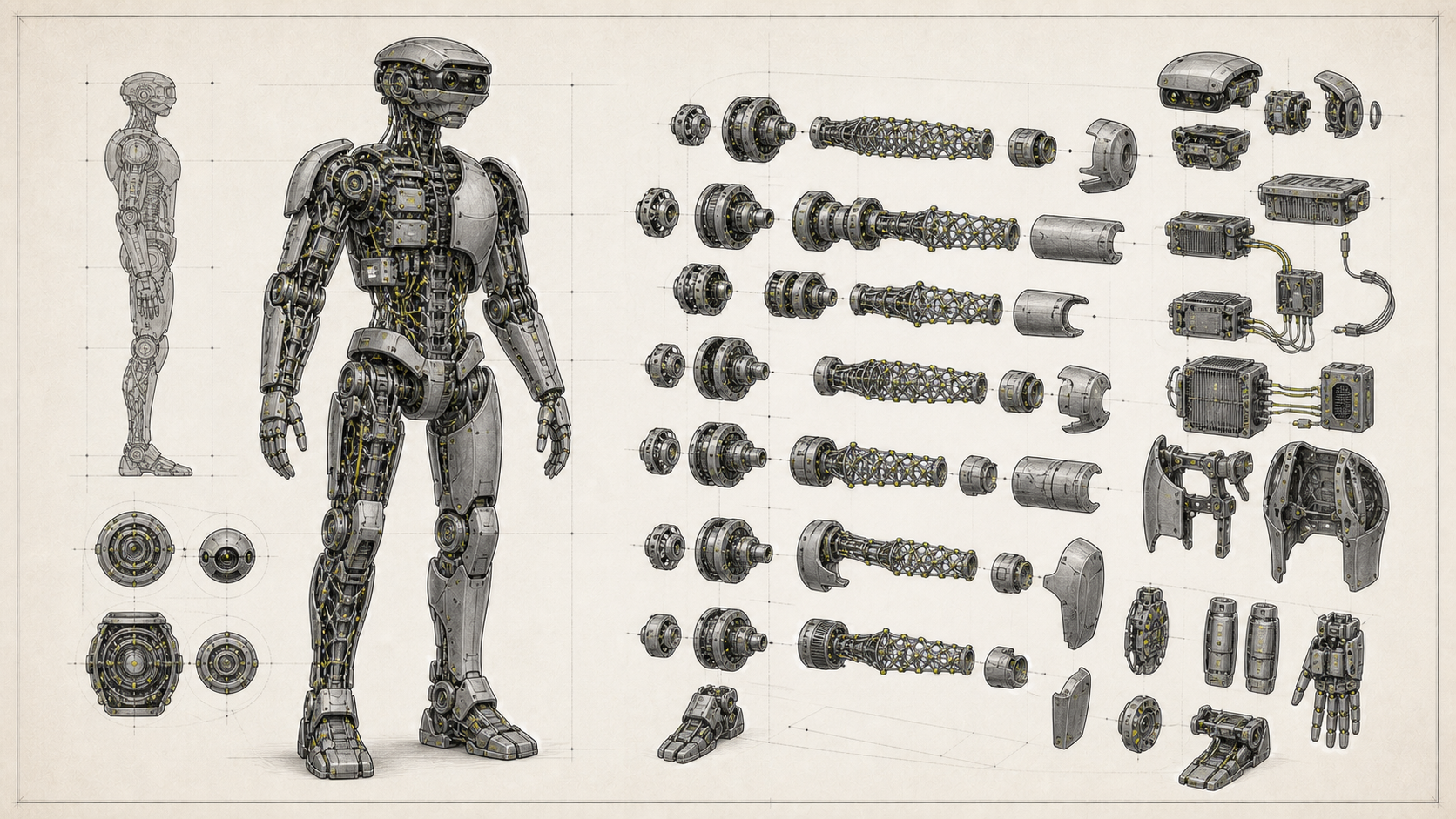
Exploded graphite blueprint of the buildable DODEXA hybrid robot system

BP—04 / Hybrid robot

Make the load path boring.
Make the research visible.

The electric joint, brake, frame, and safety controller form the dependable machine. The DODEXA tendon lives in an accessible cartridge with its own sensors, thermal boundary, bypass, and specimen identity.

Open full-resolution sheet

02 / Factory constellation

Do not build one giant factory.
Build a qualified network.

Germany and Austria already contain the capabilities needed for a first hybrid prototype. These are candidate organizations—not confirmed partners or endorsements.

R&D—01Aachen / Chemnitz

Fraunhofer ILT + IWU

Metal lattice process development, controlled porosity, scan strategy, distortion, and coupon qualification.

Official capability

AM—02Bremen / Lupburg / Düsseldorf

Materialise + FIT + voestalpine

Candidate industrial routes for LPBF production, post-processing, inspection, CT, machining, coatings, and repeatable pilot series.

Official capability

SOFT—03Lemförde / Thalheim-Wels

BASF + RICO

TPU cable protection, silicone-metal overmolding, joint boots, seals, tactile pads, and process-controlled soft interfaces.

Official capability

CTRL—04Oberpfaffenhofen

DLR Robotics and Mechatronics

Candidate research partner for modular joints, link-side torque sensing, impedance control, collision response, and advanced mechatronics.

Official capability

TEST—05Stuttgart

Fraunhofer IPA

Independent system integration and robot testing: accuracy, collision behavior, braking, stability, slopes, thresholds, and obstacle recognition.

Official capability

Commercial fit, availability, pricing, certification scope, intellectual-property terms, and NDAs must be confirmed directly before any engagement.

03 / Development order

A smaller first castle
survives longer.

Every new degree of freedom multiplies controls, energy, heat, impact, and failure. Add locomotion only after the joint and upper-body evidence is boringly repeatable.

  1. 01
    Freeze one mission

    Choose one environment and one useful task. A universal humanoid is not a first prototype.

  2. 02
    Make controlled coupons

    Compare solid, lattice, bonded, coated, and overmolded samples with traceable process records.

  3. 03
    Qualify one servo joint

    Add brakes, hard stops, dual position sensing, torque sensing, thermal limits, and accessible service points.

  4. 04
    Add the research cartridge

    Mount DODEXA beside the conventional actuator so failure is observable and bypassable.

  5. 05
    Build a fixed arm

    Resolve routing, control, interfaces, repair, and human-safe work before locomotion multiplies the problem.

  6. 06
    Move to a wheeled torso

    Prove autonomous perception and field communications on a stable mobile base.

  7. 07
    Attempt dynamic legs last

    Only after upper-body reliability, power, braking, fall strategy, and service cycles are understood.

  8. 08
    Pilot a distributed factory

    Freeze suppliers, inspection plans, specimen identity, change control, and requalification rules before series work.

04 / Better than the first concept

Keep the ambition.
Remove the single points of myth.

The improved architecture separates roles so that one material, network, or recovery mechanism cannot silently become the entire robot.

Original temptation2026 architectureWhy it is better
One miracle materialHybrid qualified structure plus isolated active-matter research cartridgesFailure remains local and measurable
Print the whole robotMachine simple links; print only complex nodes, manifolds, and instrumented latticesLower cost, better fatigue evidence, easier repair
Artificial muscle as sole driveCertified electric joint carries the mission; DODEXA assists in parallelThe robot works while the research evolves
Wireless internal controlWired deterministic local bus with physically separated safety controllerLink loss cannot remove braking or collision response
Self-healing claimDetect, isolate, align, test, then replace or requalifyRecovery becomes an evidence state
Humanoid firstFixed joint → arm → wheeled torso → dynamic legEach gate answers a smaller, cheaper question

05 / Satellite system

Starlink can be the horizon.
It cannot be the nervous system.

Starlink can connect a remote field team, but service interruption, obstruction, latency, jitter, plan eligibility, and national authorization remain real. The robot must stay safe and useful when the sky link vanishes.

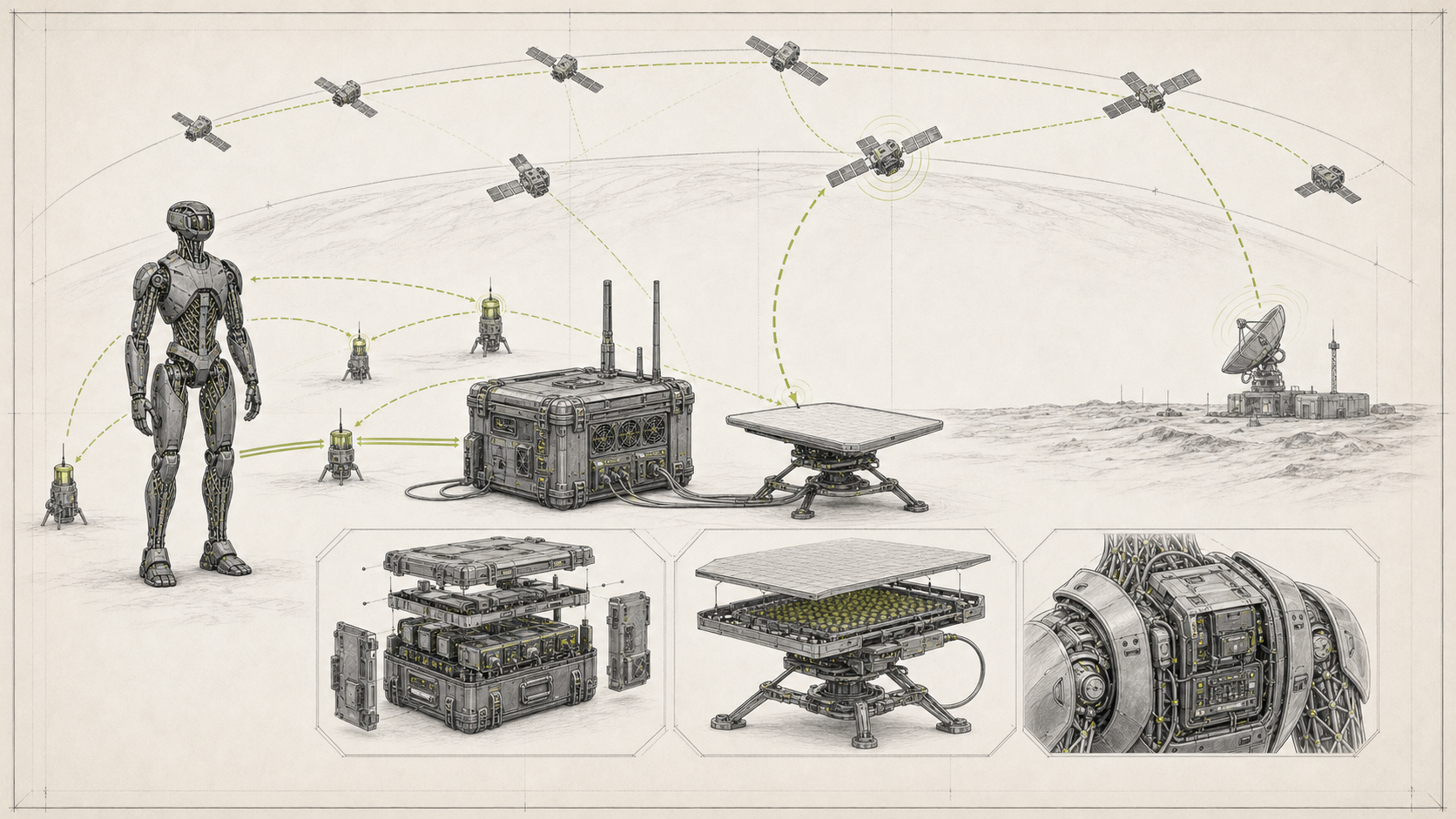
Graphite system blueprint showing a DODEXA robot connected through a local field base to a generic low-Earth-orbit satellite constellation
BP—05 / Field networkOpen full resolution
L0

Joint + safety bus

Encoders, torque sensors, drives, brakes, Safe Torque Off, and local emergency stop. Physically unreachable from the public network.

L1

Onboard autonomy

State estimation, perception, planning, local geofence, command validation, and a mission cache that survives disconnection.

L2

Field network

Private 5G, Wi-Fi mesh, or another local radio connects the robot to a nearby operator and elevated field base.

L3

Satellite backhaul

Starlink or another satellite service carries telemetry, maps, logs, compressed video, and delayed mission changes—not motor setpoints.

RECOMMENDED / FIELD BASE

Performance terminal off the robot.

Put the terminal on an elevated support vehicle or deployable mast, then connect the robot through a private local network. This improves sky view and moves terminal mass and power demand away from the mobile platform.

  • Official specification: 140° field of view and 75–100 W typical average consumption.
  • Terminal and advanced power supply together are roughly 7.3 kg.
  • Mobility, country, plan, obstruction, and installation rules must be verified for each operation.

OPTION / DETACHABLE SCOUT POD

Mini when mass matters.

A detachable Starlink Mini-class pod is more plausible for an independent scout, but it still belongs above the autonomy layer and needs a protected mount, clear sky, isolated power, and a locally safe loss-of-link state.

  • Official specification: 1.1 kg, 25–40 W average, and 110° field of view.
  • Service-plan and in-motion eligibility vary by country and use case.
  • Direct-to-cell may become a low-rate fallback, never a promised global control channel.
Control boundary

Starlink lists roughly 25–50 ms terrestrial latency in its European contract summary and does not guarantee uninterrupted service. It is suitable for supervisory missions and telemetry, not deterministic joint control or functional safety.

Link failureRequired robot response
Satellite obstructed or handing overContinue only a locally validated bounded task; otherwise enter a controlled stable stop.
Satellite and field radio lostFinish the current atomic motion, brake safely, preserve sensing, and emit a low-rate local beacon.
Delayed or duplicated commandReject it using signature, timestamp, sequence number, and short time-to-live.
Congestion or priority data exhaustedReduce video first; preserve heartbeat and event telemetry; store full logs onboard.
Terminal brownout or rebootThe communications circuit fails independently while safety control and braking remain powered.
Gateway compromiseNo path reaches the servo bus; use mutual authentication, outbound VPN, and a strict command allowlist.

Starlink is a SpaceX service. AETHER / DODEXA is not affiliated with or endorsed by SpaceX. Hardware, coverage, mobility, and service-plan availability must be confirmed at deployment time.

Continue to the global Wi-Fi + Helium fabric

06 / Evidence ledger

Primary sources.
Current capability, not borrowed certainty.

Official manufacturer, institute, standards-body, regulatory, and service-provider material. Accessed for this blueprint on 14 August 2026.

  1. 01EOS M 290 / build volume and validated metal processes
  2. 02Harmonic Drive IHD / integrated hollow-shaft servo actuator
  3. 03DLR / torque and impedance control for lightweight robots
  4. 04BASF Elastollan / flexible robot cable protection
  5. 05Fraunhofer IPA / robotics testing facility
  6. 06ISO 13849-1:2023 / safety-related control systems
  7. 07ISO 10218-1:2025 / industrial robot safety
  8. 08EU Machinery Regulation / applies from 20 January 2027
  9. 09Starlink Performance / official hardware specification
  10. 10Starlink Mini / official hardware specification
  11. 11Starlink / service terms and terrestrial latency boundary
  12. 12IETF RFC 8655 / deterministic networking scope

Return / Drawing archive

The blueprint is a decision map.
The measurements decide the machine.

Return to all blueprints