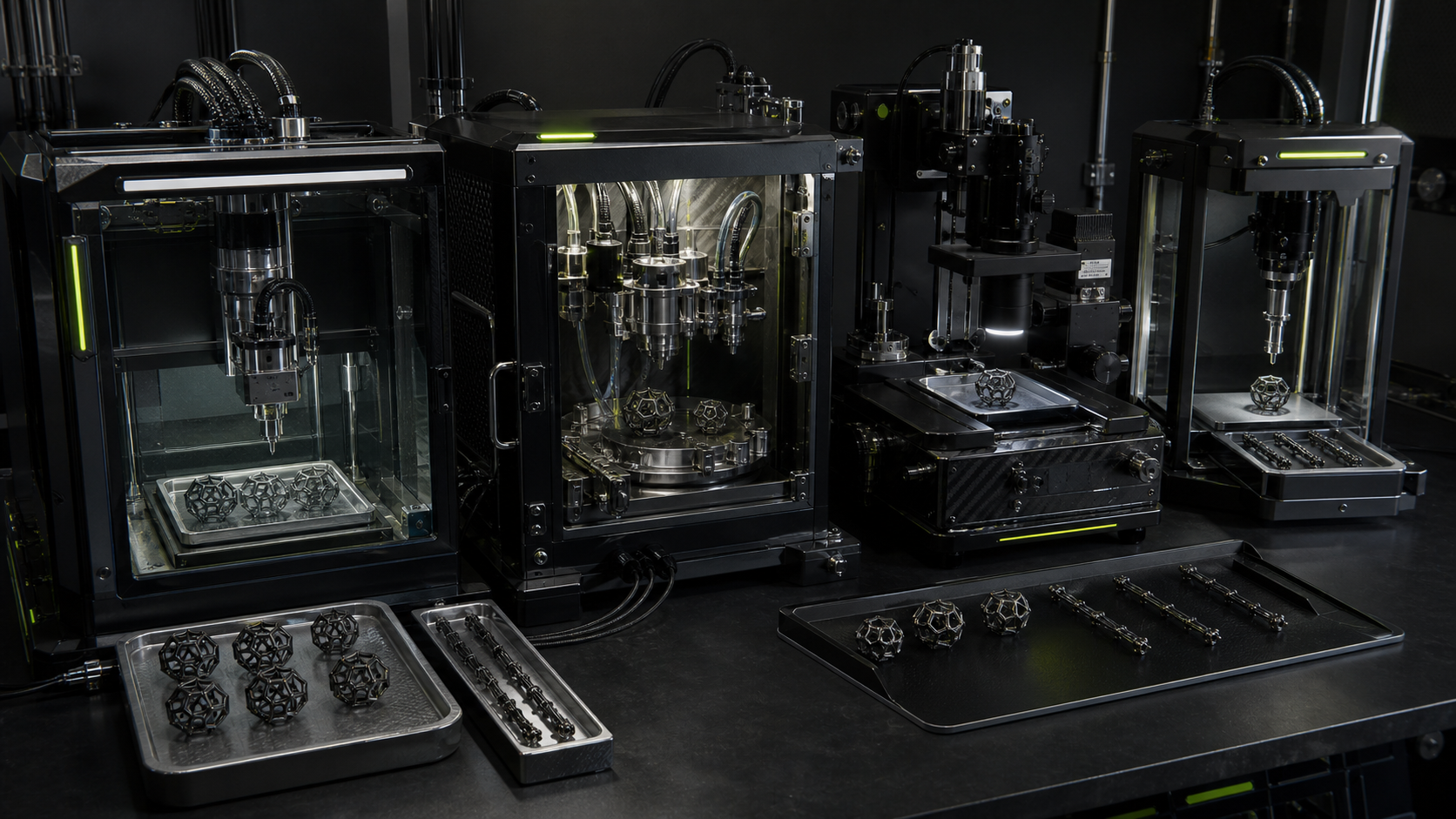
A dark AETHER materials laboratory showing additive manufacturing, coating, inspection, and DODEXA tendon assembly

AETHER / DODEXADevelopment archive 01

FROM POWDER
TO LOAD PATH.

A concept-stage fabrication and validation route for moving from isolated material behavior to one instrumented robotic joint.

BoundaryProcess hypothesis / not a fabrication manual

00 / Program boundary

The sequence is concrete.
The material stack is still under test.

These stages describe what must be controlled and measured. They do not specify a proven alloy, chemistry, voltage, field strength, pressure, cure cycle, or human-safe operating envelope. Those values belong to experiments, risk review, and qualified specialists.

01 / Development sequence

Six gates.
One honest chain of evidence.

Every stage has an intent, a process hypothesis, and a condition that stops the work before complexity hides the failure.

01

Define the coupon

Freeze geometry, material lot, build orientation, specimen identity, and control samples before adding active behavior.

Process hypothesis
Print passive lattices and solid references from the same feedstock. Record machine state and surface condition.
Gate / failure check
Reject the batch when dimensions, mass, or surface defects fall outside the declared build window.
02

Print the load path

Create a repeatable rhombic-dodecahedral skeleton whose mechanical behavior can be separated from later coatings.

Process hypothesis
Build, depowder, clean, inspect, and condition the bare lattice before any node or active phase is attached.
Gate / failure check
Map strut buckling, node fracture, and directional stiffness. Compare equal-mass simpler lattices.
03

Add the active skin

Introduce a candidate electro-ionic or surface-stress layer without concealing damage in the structural core.

Process hypothesis
Prepare the surface, deposit a traceable coating stack, add electrical access, and measure adhesion independently.
Gate / failure check
Stop on cracking, delamination, drift, uncontrolled heating, or motion indistinguishable from thermal expansion.
04

Place field nodes

Give compatible cells a remote alignment and docking mechanism while preserving the passive load path.

Process hypothesis
Install magnetically responsive junctions with controlled polarity, position, retention, and safe field exposure.
Gate / failure check
Measure node pull-out, docking tolerance, hysteresis, stray coupling, and the state after field loss.
05

Encapsulate the tendon

Protect chemistry and electrical interfaces without locking the lattice or trapping damaging heat.

Process hypothesis
Route local buses and sensing, then apply a compliant barrier with service access at cartridge boundaries.
Gate / failure check
Reject pinholes, shorts, loss of range, excessive damping, heat accumulation, or unserviceable joints.
06

Measure, fail, iterate

Turn motion into a reproducible operating envelope rather than a cinematic one-off demonstration.

Process hypothesis
Calibrate the fixture, run passive controls, sweep one variable at a time, and keep raw data tied to each specimen.
Gate / failure check
Advance only when uncertainty, stop conditions, degradation, and repeatability are recorded with the result.
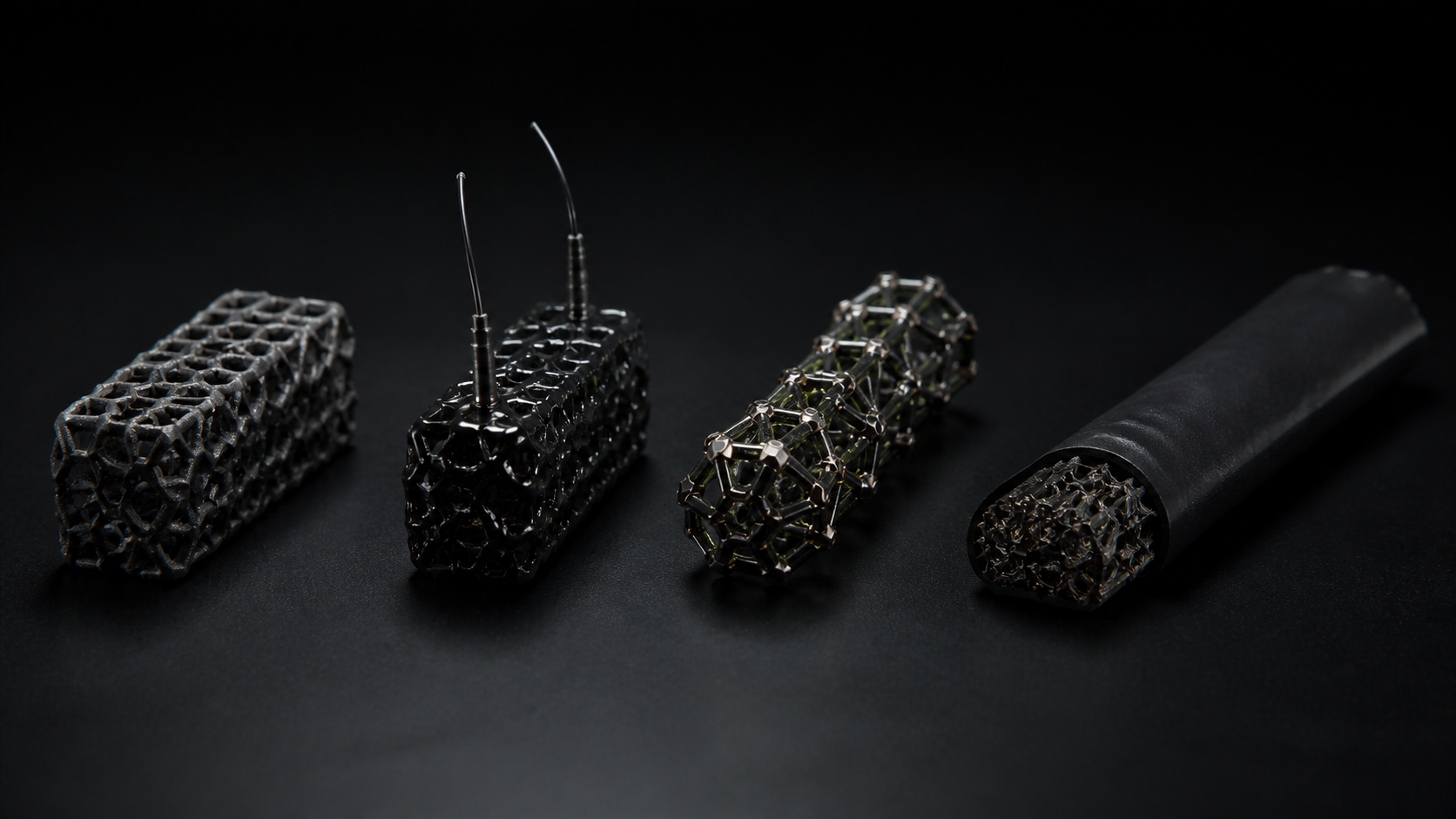
Four DODEXA development artifacts: raw lattice, coated coupon, magnetic-node chain, and encapsulated tendon

02 / Artifact ladder

Complexity arrives
one interface at a time.

Each artifact should survive inspection before its behavior is allowed to disappear inside the next assembly.

  1. A
    Raw lattice

    Geometry, mass, surface, stiffness, and failure map.

  2. B
    Active coupon

    Coating adhesion, electrical continuity, reversible response, and heat.

  3. C
    Field-node chain

    Polarity, retention, registration, coupling, and field-loss behavior.

  4. D
    Encapsulated tendon

    Routing, barrier integrity, service access, damping, and load sharing.

03 / Joint demonstrator

One joint.
Every failure visible.

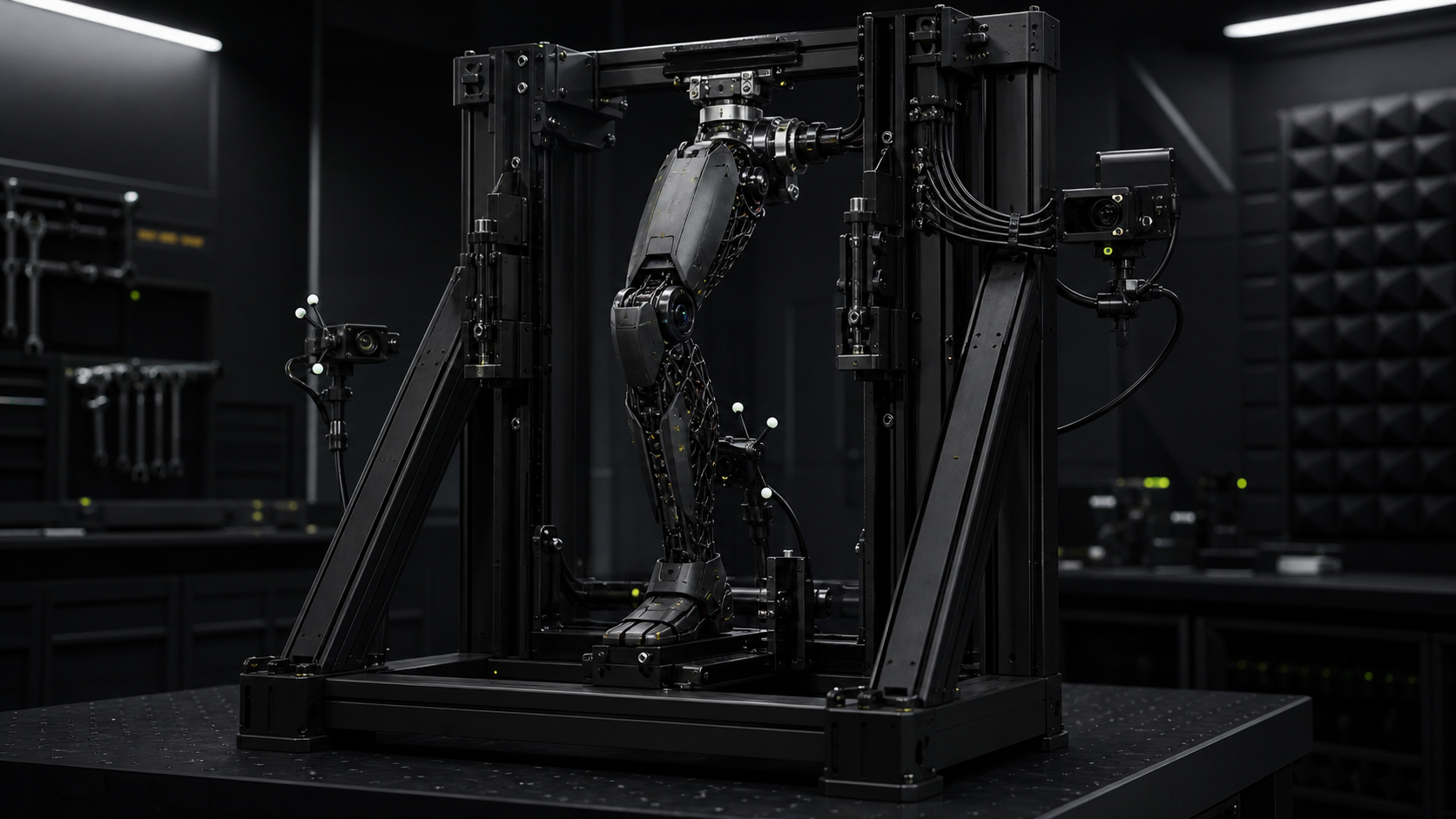
The first robotic integration is deliberately fixed to a bench. It adds tendon routing, leverage, sensing, control latency, mechanical stops, and realistic duty cycles while staying inspectable and serviceable.

Read the program note
Instrumented DODEXA robotic knee and leg test rig with visible lattice tendons and optical, load, and thermal measurement
JR—01 / Concept rigMotion is necessary. Understanding is the milestone.

04 / Measurement ledger

Instrument the claim.

A test ends safely when the specimen crosses a predeclared boundary—not when the render looks complete.

PropertyEvidence channelStop / reject condition
GeometryOptical scan / mass / surface recordBuild variance or hidden defects exceed the declared specimen window
Force + displacementLoad cell / encoder / optical strainUnstable buckling, fixture slip, or irrecoverable set
ElectricalFour-wire resistance / current / isolationShort, discontinuity, leakage, or unexplained drift
ThermalThermography / embedded temperatureLocalized hot spot or barrier temperature is exceeded
FatigueCycle counter / synchronized signalsProperty loss crosses the predeclared service boundary
RecoveryPre/post signature comparisonAlignment returns without qualified strength, motion, and continuity

Continue / Drawing archive

See what every artifact
is trying to become.

Open DODEXA blueprints