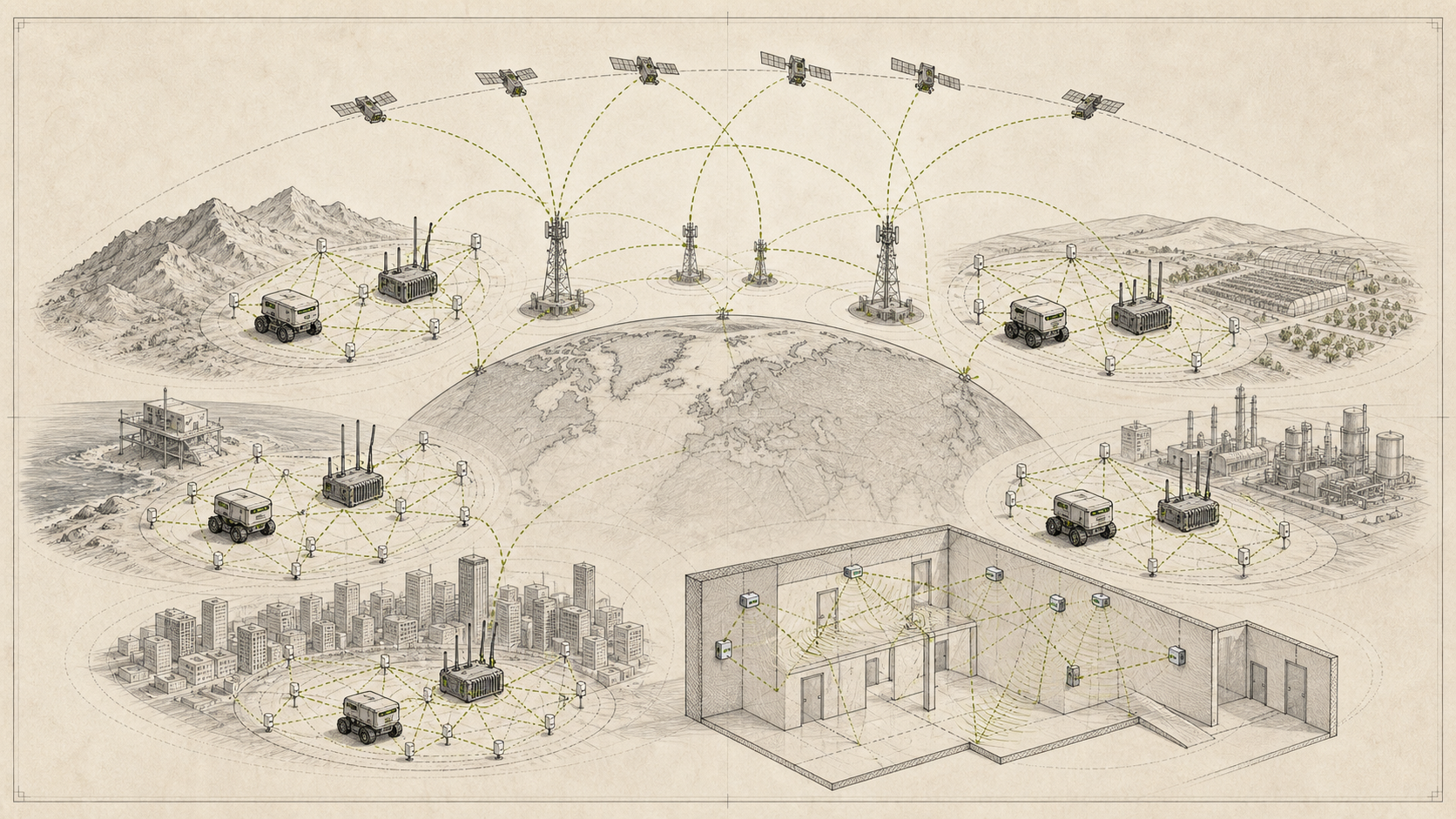
A world-scale robot project should federate trust, evidence, and maps—not pretend the planet is one giant Wi-Fi network. Every site remains locally safe, locally governed, and useful when the wider constellation disappears.
“All Wi-Fis communicate” becomes a controlled federation: enrolled local cells advertise approved services, portable identities request access, and encrypted gateways exchange only authorized data.
It is not arbitrary router joining, a planetary layer-2 mesh, or public access to robots. Each venue owns its spectrum plan, admission policy, privacy duty, physical anchors, and safe-loss response.
01 / Radio generations
Deploy six and seven. Prepare for eight. Do not invent nine.
Generation labels describe interoperable WLAN capability. They do not make a public radio deterministic, globally legal, or suitable for functional safety.
06DEPLOY NOW
Wi-Fi 6 / 6E
Use Wi-Fi 6 as the mature dense-cell baseline. Wi-Fi 6E extends compatible equipment into 6 GHz where the country permits it; it is a spectrum option, not a different safety architecture.
Use certified Wi-Fi 7 for high-rate perception transfer, local model delivery, and resilient client access. Multi-Link Operation can use more than one link, but its gain depends on both endpoints, spectrum, interference, and implementation.
MLO improves transport / it does not certify robot control
08ROADMAP
Wi-Fi 8 / IEEE 802.11bn
Track the active Ultra High Reliability project for future cell upgrades and smoother operation across overlapping access points. Keep procurement and safety cases on ratified, testable equipment until the draft becomes an adopted standard and certified ecosystem.
Reserve upgrade paths / do not depend on draft behavior
09RESEARCH HORIZON
Wi-Fi 9
There is no defined IEEE 802.11 Wi-Fi 9 standard to specify today. Treat the name as a future-research horizon, not a capability claim, product requirement, or deployment promise.
Observe study groups / publish no invented specification
BP—06 / Global field fabric
The world map is an index. The cell is the machine.
The global plane distributes identity roots, signed policy, approved software, evidence schemas, and delayed mission packages. Real-time perception, positioning, planning, and safety remain inside the local cell.
Portable identity reduces friction. It never grants implicit authority over a machine, a building, or a person.
L0
Robot safety island
Brakes, torque limits, collision response, joint control, and emergency stop remain on deterministic local hardware. No public radio, roaming service, or WAN can address the servo bus.
L1
Local AP fabric
A site-owned Wi-Fi 6E or 7 cell uses surveyed access points, wired backhaul where practical, segmented robot and operator networks, local positioning anchors, and an onsite edge controller.
L2
Portable identity
Device certificates and policy travel; trust does not become universal. Passpoint or OpenRoaming may provide explicit, opt-in access for people and approved devices while each site retains admission control.
L3
Encrypted overlay
Mutually authenticated tunnels connect approved edge gateways to regional services. The overlay carries signed tasks, telemetry, maps, and updates through strict allowlists—not raw LAN adjacency.
L4
Regional edge
Policy, data residency, language, incident response, and model distribution are hosted by jurisdiction. A global project can share a protocol without exporting every site’s sensitive data.
L5
Store-and-forward horizon
Fiber, private cellular, or satellite may carry normal backhaul. Helium IoT may carry a tiny delayed heartbeat. Every external path can disappear while the local cell remains safe and auditable.
03 / Physical spectrum
Walls are physics. Countries are policy.
No Wi-Fi generation simply “sees through walls.” Lower frequencies often penetrate some materials more effectively, while metal, water, reinforced concrete, foil-backed insulation, geometry, and interference can defeat every band.
2.4 GHz
Reach + resilient low rate
Often reaches farther and crosses some common building materials better than higher bands, but has less spectrum and more legacy interference. Keep it for discovery, low-rate operations, and deliberate fallback—not precision claims.
5 GHz
Operational workhorse
Usually the practical balance of capacity, device support, and cell size. Channel availability, transmit power, and radar-sharing requirements such as DFS vary by jurisdiction and channel.
6 GHz
Clean local capacity
Offers wider clean channels for compatible 6E and 7 equipment, with shorter practical reach and greater obstruction loss. Indoor, low-power, and coordinated outdoor modes depend on regional authorization.
Build a country profile before transmitting: permitted channels, power, indoor or outdoor classification, dynamic-frequency selection, automated-frequency coordination, equipment approval, and 6 GHz availability differ by jurisdiction and can change.
04 / Wi-Fi 7 boundary
More links. One explicit trust domain.
Multi-Link Operation can improve throughput, latency distribution, and resilience by coordinating links, but it is not a license to bridge every visible access point.
DO
Coordinate enrolled links.
Use compatible certified endpoints, site-managed channels, measured roaming behavior, bounded queues, and transport metrics exposed to the local autonomy layer.
DO NOT
Treat MLO as safety redundancy.
Links may share power, radios, interference, firmware, and backhaul. A multi-link association is not independent braking, positioning, or emergency-stop evidence.
NEVER
Auto-join a stranger’s router.
Unknown APs can advertise plausible names and strong signals. Enrollment, authenticated discovery, certificate policy, segmentation, and revocation decide membership—not proximity.
05 / Positioning fabric
Position comes from geometry. Confidence comes from disagreement.
Wi-Fi round-trip timing becomes useful when anchors are measured, geometrically diverse, and fused with independent motion evidence. Signal strength alone is not a dependable indoor coordinate.
01
Surveyed geometry
Give every enrolled anchor a measured coordinate and height. Use at least three well-separated anchors for a constrained 2-D solution and four or more for 3-D; add redundancy and avoid near-collinear placement.
02
Round-trip ranging
Use IEEE 802.11az-capable ranging where supported. Treat reported range uncertainty as an input to the estimator, not as a guaranteed location fix.
03
Independent motion evidence
Fuse Wi-Fi range with IMU, wheel or joint odometry, UWB where justified, visual or lidar landmarks, and GNSS outdoors. No single radio observation owns the pose.
04
Confidence-gated behavior
Model multipath and changing floor plans, monitor anchor health, and attach uncertainty to every estimate. Slow or stop when positioning confidence falls below the task’s validated threshold.
06 / Privacy-governed RF sensing
Sense channel change. Do not claim x-ray vision.
IEEE 802.11bf defines WLAN sensing mechanisms. In controlled conditions, changes in the radio channel may support coarse presence, motion, gesture, or occupancy features—even when transmitter and receiver are separated by some non-metallic walls. The result is probabilistic RF evidence, not a photograph, identity, or guaranteed view of another room.
PHYSICAL LIMIT
Material and geometry decide.
Metal, reinforcement, water-rich materials, foil insulation, distance, multipath, moving machinery, people, antenna placement, and frequency can erase or imitate a useful signature.
DECISION LIMIT
Unknown remains unknown.
RF sensing never proves that a room is empty, identifies a person, or certifies a collision-free path. Safety decisions require direct local sensors and conservative uncertainty.
PRIVACY LIMIT
Consent before capability.
Keep sensing off by default. Define the zone and purpose, show visible status, process features locally, minimize retention, block identity inference, audit access, and provide a physical or administrative disable path.
No covert mode. No hidden occupancy scoring. No export of raw channel-state data by default. A legal and human review precedes every sensing deployment.
07 / Helium boundary
A faint pulse at the edge. Never the robot’s bloodstream.
Helium operates distinct IoT and mobile-offload networks. They solve different problems and remain isolated from robot control, positioning, and primary backhaul.
HELIUM IOT / LORAWAN
Tiny delayed lifeline.
A separately powered LoRaWAN module may emit a compact signed heartbeat, fault code, last known coarse breadcrumb, and recovery status when normal links fail. Community gateways forward encrypted small packets toward the chosen network server.
Small, infrequent, delay-tolerant payloads only.
Coverage, duty cycle, downlink, gateway health, and regional frequency plan are external constraints.
No motion commands, live navigation, video, safety acknowledgement, map stream, or software update.
HELIUM MOBILE / PLUS
Optional isolated carrier offload.
Compatible Passpoint access points can participate in carrier offload for supported subscribers and service-provider arrangements. That can help operator phones or ordinary data devices—not create a universal private robot network.
Use a separate subscriber VLAN and local breakout.
Keep identity exchange protected through the supported AAA and RadSec design.
Country availability, hardware compatibility, service-provider participation, coverage, and terms must be confirmed.
08 / Graceful degradation
Global by federation. Resilient by disconnection.
The important behavior is not how many networks can connect. It is what the local machine does when each one fails, lies, drifts, or becomes unlawful.
Failure or change
Required local response
One Wi-Fi link or MLO band fails
Remove the degraded link, reduce throughput, and continue only if the remaining local path and pose confidence satisfy the task envelope.
Local AP or wired backhaul fails
Roam only to an enrolled cell. Never join an arbitrary nearby router; slow or enter a stable stop if local service cannot be re-established.
Identity or policy service is unreachable
Honor only short-lived cached authorization for the current cell. Admit no new trust and queue audit records locally.
6 GHz is unavailable or unlawful
Use the validated 5 GHz or 2.4 GHz profile with lower capacity. Country policy overrides desired performance.
Positioning anchors disagree
Reject outliers, widen uncertainty, cross-check independent sensors, and leave the autonomous task envelope before pose becomes unsafe.
RF sensing is blocked or ambiguous
Report unknown. Never translate weak channel evidence into an assertion that a room is empty or a route is clear.
Every WAN path is partitioned
Run the locally cached bounded mission, or stop safely. Preserve signed events and bulk logs for later store-and-forward synchronization.
Helium heartbeat is delayed or absent
No motion or safety behavior changes. Buffer the breadcrumb, retry within regional radio limits, and use another approved channel when available.
09 / Global rollout gates
Prove one cell. Then federate the evidence.
A global project grows through repeatable local acceptance—not a single switch that exposes every site.
G01
Local mission charter
Name the task, operator, site owner, safety boundary, and useful offline behavior before selecting radios.
G02
Jurisdiction matrix
Record permitted bands, power, indoor or outdoor mode, equipment approval, privacy law, retention, and telecom obligations for every country.
G03
Reference cell
Freeze a reproducible AP, switch, edge gateway, identity, monitoring, and segmentation profile with signed configuration history.
G04
RF + anchor survey
Measure obstruction, interference, roaming edges, round-trip range error, floor changes, and failure coverage at the actual site.
G05
Trust enrollment
Issue revocable device identities, site policy, and short-lived authorization. OpenRoaming remains an explicit service, never automatic robot trust.
G06
Sensing consent gate
Complete privacy review, publish the zone and purpose, test material limits, enable visible status, and prove deletion before sensing is activated.
G07
Partition trials
Cut each AP, band, anchor, gateway, regional service, Helium path, and WAN in turn; verify deterministic degraded behavior.
G08
Federated pilot
Connect multiple independently governed sites only after each local cell passes the same conformance and operator-acceptance tests.
10 / Evidence ledger
Standards before slogans. Local law before radio ambition.
Primary standards, regulator, platform, and protocol sources used for this concept blueprint. Capability and availability must be rechecked for each country and procurement date.