Complex prototypes hide causes. A full robot can move badly for a hundred reasons, which makes it a poor first experiment. The DODEXA program reduces the problem until each failure belongs to a small, inspectable artifact.
Four gates—coupon, unit cell, tendon bundle, and joint demonstrator—create a chain of evidence. A later gate never repairs a weak result from an earlier one.
DODEXA is a proposed integrated architecture. Constituent research is cited; combined performance remains an experimental question.
01 / J—04
Gate one: isolate the active phases
Material coupons establish whether each candidate phase produces reversible behavior under controlled chemistry, voltage, field, temperature, and humidity. The output is not a marketing number. It is a set of curves, uncertainties, and failure surfaces.
The baseline includes passive samples made with the same geometry and process but without the active ingredient. Without that control, thermal drift and fixture compliance can masquerade as actuation.
02 / J—04
Gate two and three: assemble consequences
The unit-cell gate introduces interfaces: nodes, coatings, buses, porous layers, and encapsulation. The tendon gate introduces accumulation. Small variation across many cells can create friction, phase lag, hot spots, and unequal load sharing.
Instrumentation should scale with the artifact: displacement and force for every gate; electrical and thermal maps when active layers arrive; optical strain and acoustic or resistance-based damage signals when a bundle begins to carry load.
03 / J—04
Gate four: one joint, every failure
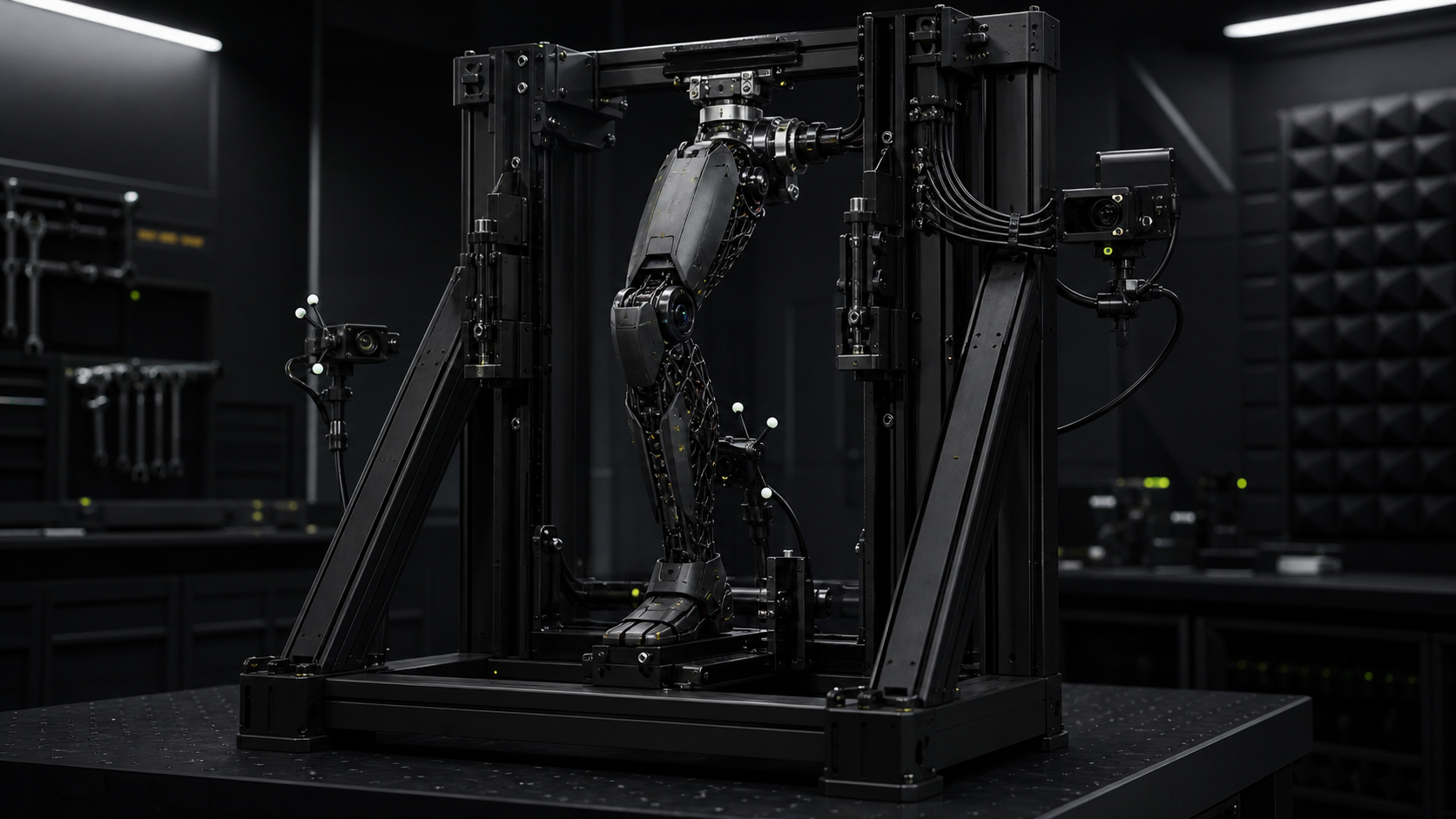
The joint rig adds routing, leverage, control latency, mechanical stops, and real duty cycles. It should be deliberately over-instrumented and easy to service. The purpose is to expose coupling, not to look autonomous.
A successful gate is a repeatable result with traceable uncertainty, a known stop condition, and a specimen another team can build. Motion is necessary. Understanding is the actual milestone.
- Publish the configuration and calibration state with every result.
- Keep raw and processed signals linked to the same specimen identity.
- Record failures as program output, not discarded anomalies.
- Advance only when the next artifact answers a question the current one cannot.
Primary literature