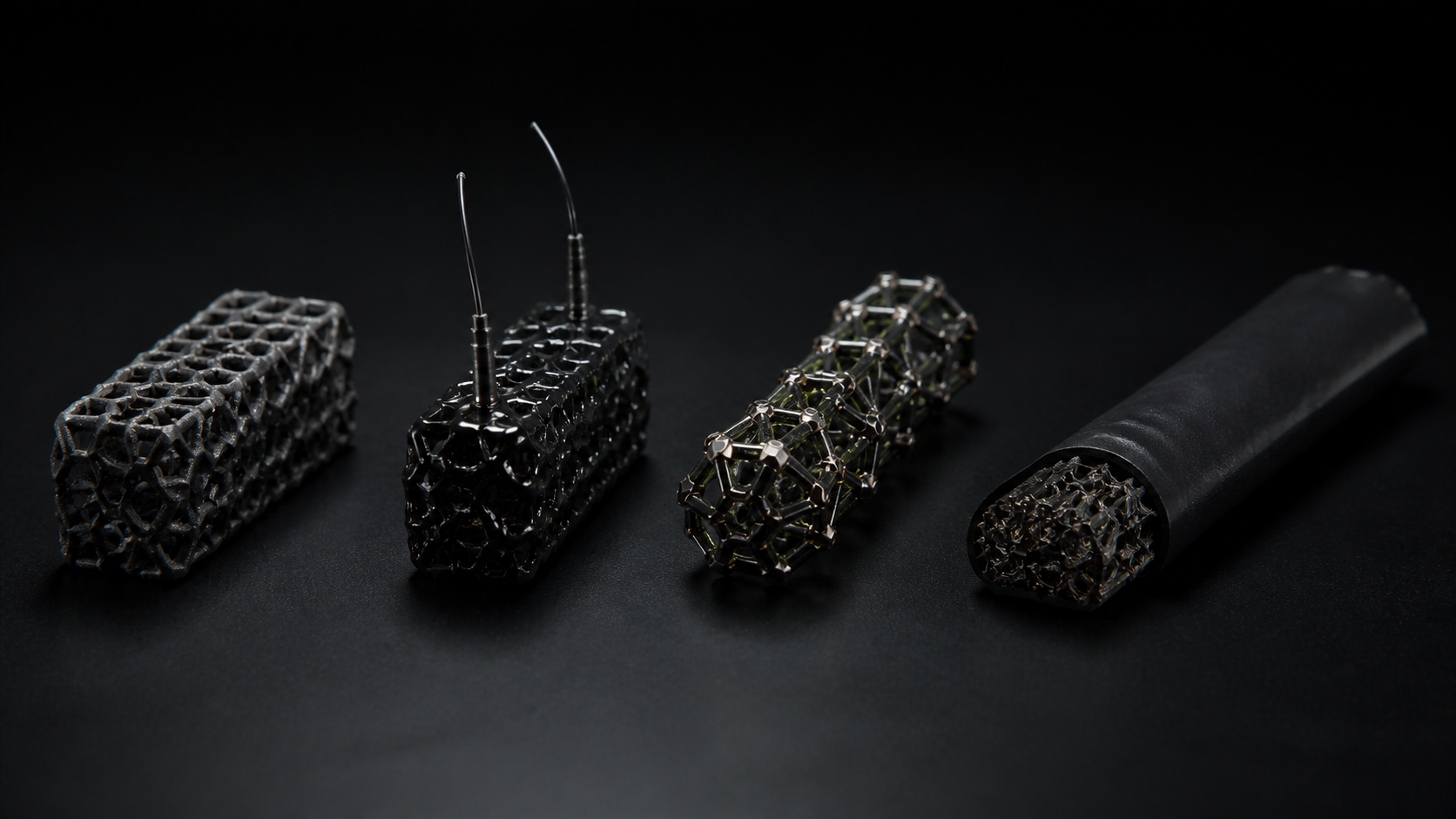
Porous materials can change when guest molecules enter, leave, or rearrange inside them. That behavior suggests a DODEXA layer that biases shape, tunes stiffness, or senses a specific environment. It does not imply that ordinary air will power a practical robot muscle.
Every useful response belongs to a defined guest, concentration, temperature, humidity, pressure, geometry, and cycle history. The atmosphere is part of the test fixture.
DODEXA is a proposed integrated architecture. Constituent research is cited; combined performance remains an experimental question.
01 / J—05
Start in a chamber, not on a robot
Guest-responsive candidates should first be tested as isolated films or coated lattice coupons inside a controlled chamber. Mass uptake, dimensional change, force, rate, desorption, and baseline drift must be measured together.
Humidity and contamination deserve their own controls. A response that looks selective in a clean vessel may disappear, slow, or become irreversible in a real operating environment.
02 / J—05
Bias and sensing before primary actuation
A slow guest-responsive phase may be more valuable as a bias spring or integrated chemical sensor than as the main source of motion. It could change the resting geometry of a tendon while magnetic and electro-ionic phases handle faster commands.
That division gives the atmospheric layer a narrow, testable job and reduces the temptation to describe every observed strain as a general-purpose artificial muscle.
- Define the target guest and reject broad ‘gas responsive’ claims.
- Measure adsorption and desorption across full cycles.
- Track swelling force as well as free strain.
- Design safe purge, containment, and end-of-life procedures before scaling.
03 / J—05
The claim boundary
Flexible porous frameworks have demonstrated guest-triggered crystal deformation, while nanoporous gold has demonstrated surface-chemistry-driven strain under specific gases. DODEXA proposes to learn from those mechanisms; it does not claim that either material can be dropped unchanged into a robot tendon.
The first milestone is a reproducible coupon response with a complete atmospheric record. Everything beyond that remains architecture work.
Primary literature