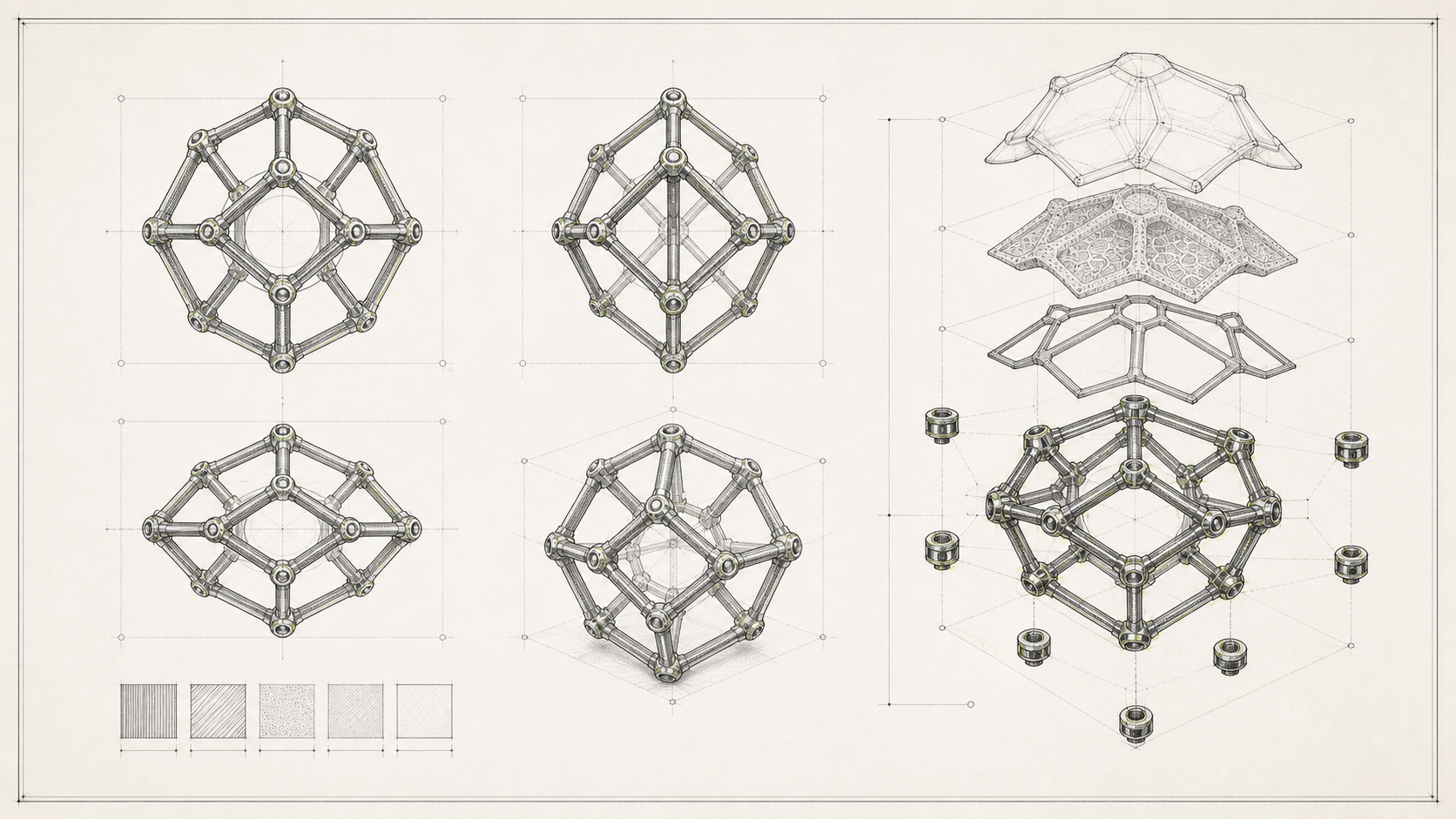
A lattice can distribute load, localize damage, and create room for active material. It cannot produce useful motion by geometry alone. DODEXA treats the rhombic-dodecahedral cell as a mechanical chassis for several candidate active phases—not as a material with magical properties.
That distinction is the first guardrail of the program. The cell earns its place only if printed specimens outperform simpler architectures under the same mass, volume, and manufacturing constraints.
DODEXA is a proposed integrated architecture. Constituent research is cited; combined performance remains an experimental question.
01 / J—01
Geometry before mythology
The rhombic dodecahedron fills three-dimensional space without gaps. That makes it attractive for a modular tendon: neighboring cells can share faces, nodes can become service interfaces, and a bundle can be assembled from a finite vocabulary of repeatable parts.
But published mechanical work on open-cell rhombic-dodecahedral structures describes bending-dominated and direction-dependent behavior. DODEXA therefore does not claim perfect isotropy. Directional stiffness is a design variable to measure and, if useful, deliberately orient around a joint.
02 / J—01
What the cell must carry
The proposed cell separates four jobs: a structural lattice carries load; magnetic junctions provide registration and remote bias; an electro-ionic phase provides local trim; and a porous guest phase remains an optional environmental input. Keeping those functions distinguishable makes failure easier to diagnose.
The interfaces are likely to be harder than the struts. Coating cracks, node pull-out, encapsulation delamination, and electrical discontinuity can all destroy the system long before the geometry reaches its theoretical limit.
- Measure print variance and surface condition before adding active layers.
- Test stiffness and buckling along every principal orientation.
- Map failure to nodes, struts, coatings, and interfaces separately.
- Compare against a simpler lattice at equal mass and envelope.
03 / J—01
The first honest deliverable
The first useful DODEXA artifact is not a humanoid robot. It is a small coupon with known geometry, traceable fabrication parameters, and a force-displacement curve that another lab could reproduce.
If the cell cannot be manufactured repeatably, instrumented cleanly, and failed safely, the kingdom has no foundation. The correct response is iteration at coupon scale—not a more dramatic render.
Primary literature