A robot muscle can be free of signal wires and still require energy, heat rejection, sensing, and a return path. The useful question is not whether DODEXA is ‘wireless.’ It is which function crosses the air, which function remains local, and what happens when either channel disappears.
The current concept assigns fast geometric bias and alignment to an external magnetic field, then reserves low-voltage electro-ionic control for local trim. That split is a hypothesis to test, not a finished controller.
DODEXA is a proposed integrated architecture. Constituent research is cited; combined performance remains an experimental question.
01 / J—02
Three channels, three responsibilities
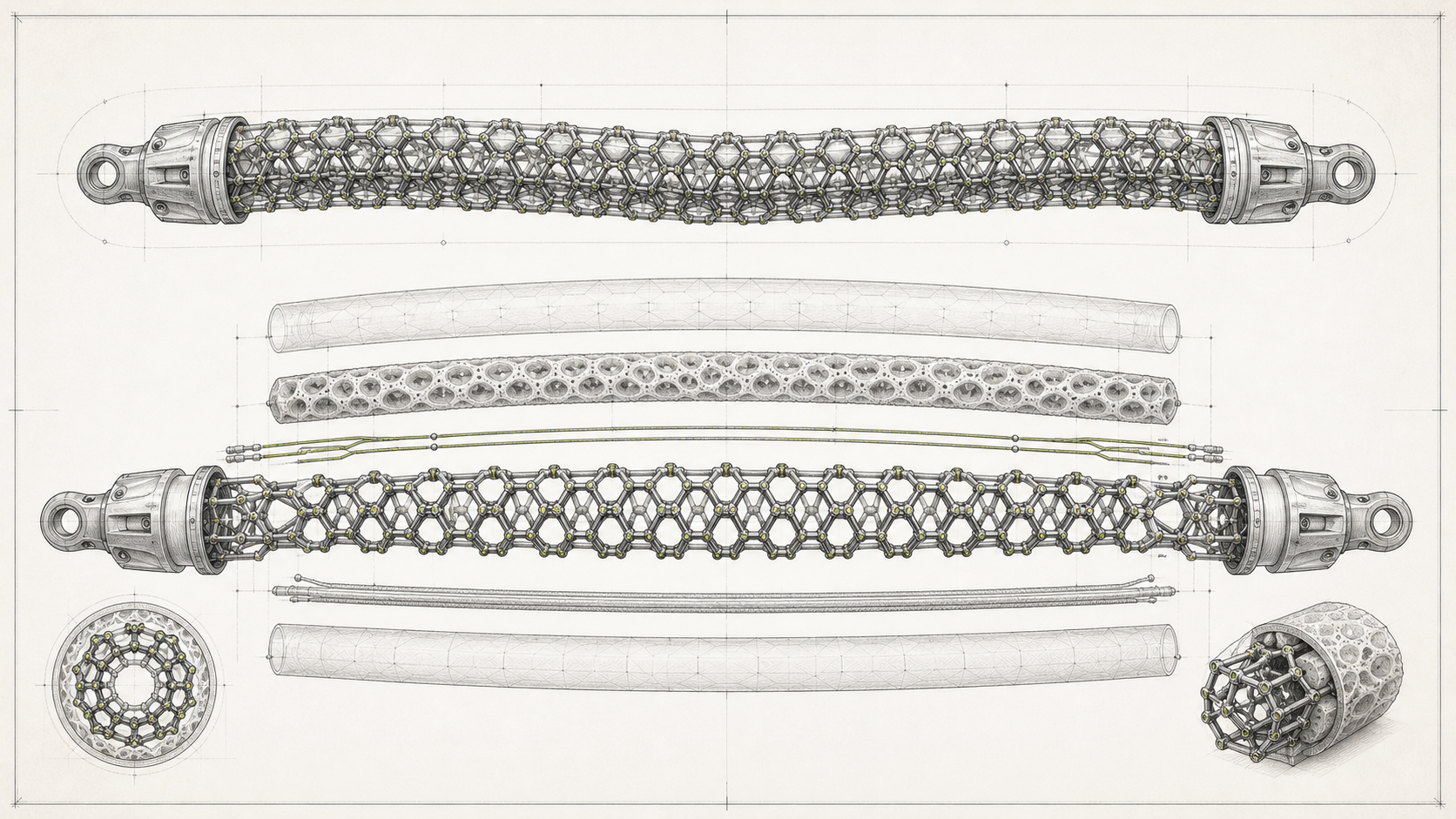
The field channel carries address and coarse actuation. An inductive or onboard electrical channel supplies local electro-ionic work. The mechanical lattice carries load and must remain stable when both active channels are absent.
A safe default state matters. Loss of the external field should not turn a limb into an uncontrolled spring, while loss of local electrical control should leave enough passive stiffness for the robot to stop or lower a load.
- Remote magnetic field: alignment, bias, docking, and coarse shape change.
- Local low-voltage circuit: cell-level trim, sensing, and state estimation.
- Passive lattice: fail-safe load path and serviceable mechanical boundary.
02 / J—02
What the literature actually demonstrates
Researchers have printed ferromagnetic domains into soft composites and driven rapid, reversible transformations with external fields. Separately, nanoporous metals have shown reversible charge-induced strain. Neither result is a DODEXA tendon, and neither paper establishes the combined architecture.
The bridge from constituent behavior to a robot joint requires a control map: field strength and direction, local voltage, cell temperature, displacement, force, hysteresis, and time. Without that map, ‘hybrid’ is only a word.
03 / J—02
Wireless must fail gracefully
The joint demonstrator should be tested first with deliberate communication loss, field loss, power loss, sensor disagreement, and thermal limits. A controller earns trust by making those failures boring.
DODEXA’s wireless claim should eventually describe a verified operating envelope: range, field geometry, response latency, local energy budget, electromagnetic compatibility, and the mechanical state after disconnection.
Primary literature