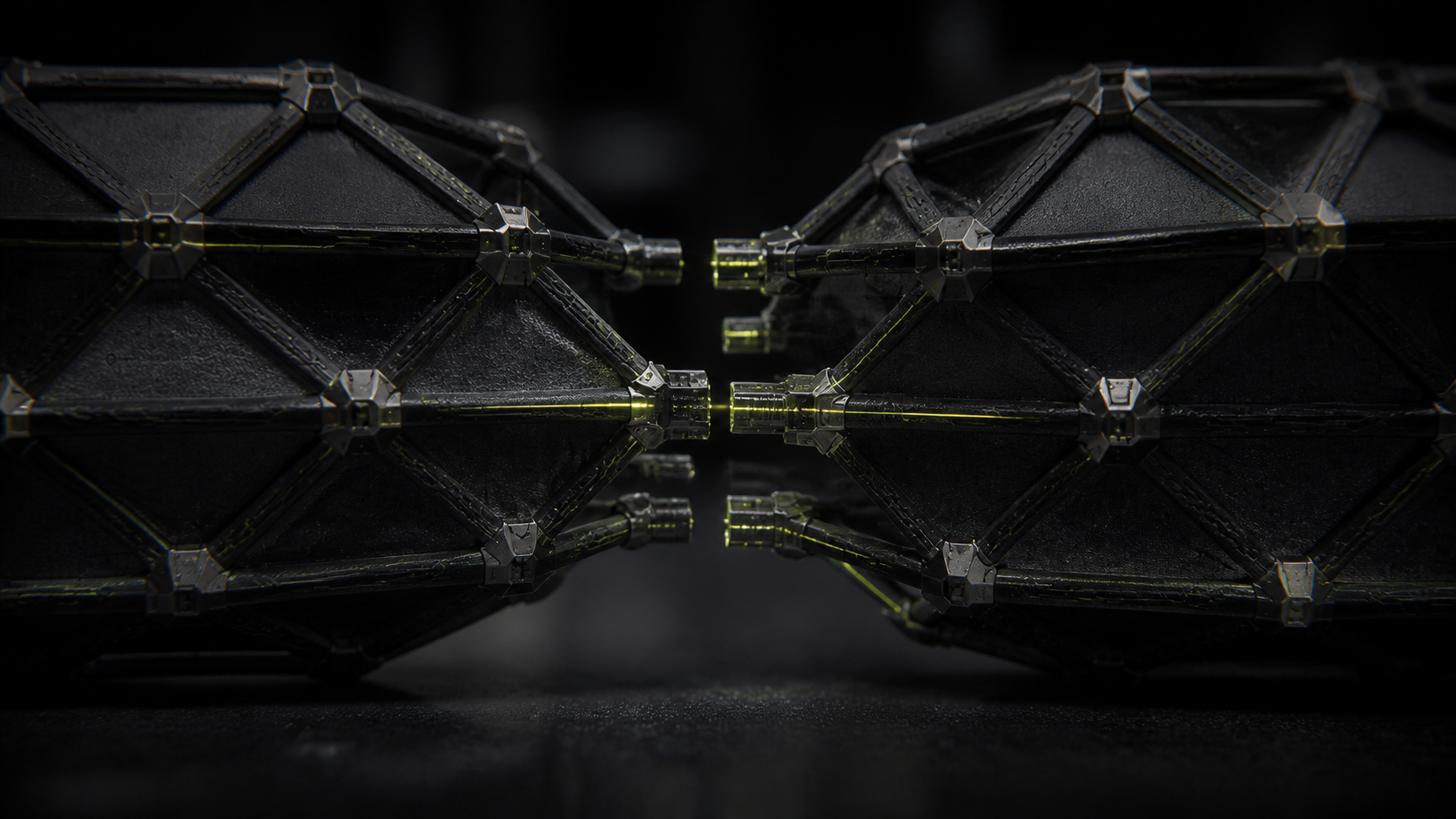
Self-healing is seductive language because it compresses several different events into one word. Pieces may find each other. A surface may rebond. Conductivity may return. None of those outcomes proves that the original strength, motion, or fatigue life has returned.
DODEXA therefore treats repair as a sequence of observable states: detect, align, bridge, and requalify. The final state can still be ‘replace the cartridge.’
DODEXA is a proposed integrated architecture. Constituent research is cited; combined performance remains an experimental question.
01 / J—03
Alignment is not healing
Magnetic nodes could help compatible fracture faces register when they are brought into range. That is mechanically useful even if no bond reforms: alignment can simplify field service and keep a damaged segment from drifting.
Dynamic polymer networks demonstrate that designed bonds can exchange and restore part of an interface under particular conditions. That result does not imply autonomous repair of a metal lattice, a coating stack, or a complete tendon.
02 / J—03
The requalification loop
After reconnection, the controller must compare the segment with its pre-damage signature. The minimum ledger includes electrical continuity, neutral length, stiffness, force-displacement behavior, thermal response, and noise from embedded sensing.
Recovery should be reported as a fraction of the relevant property and for a defined number of cycles. A single successful pull after a cut is demonstration theatre, not service qualification.
- Confirm geometry and node registration.
- Measure conductivity under motion, not only at rest.
- Run a reduced load cycle before returning to service.
- Quarantine the segment when any signature falls outside its approved band.
03 / J—03
Replaceability is also resilience
A modular cartridge that can be removed quickly may be more valuable than a material that heals slowly or unpredictably. DODEXA keeps both routes open: recover when the evidence permits; replace when it does not.
The design goal is not immortality. It is controlled degradation, clear diagnosis, and a safe path back to function.
Primary literature